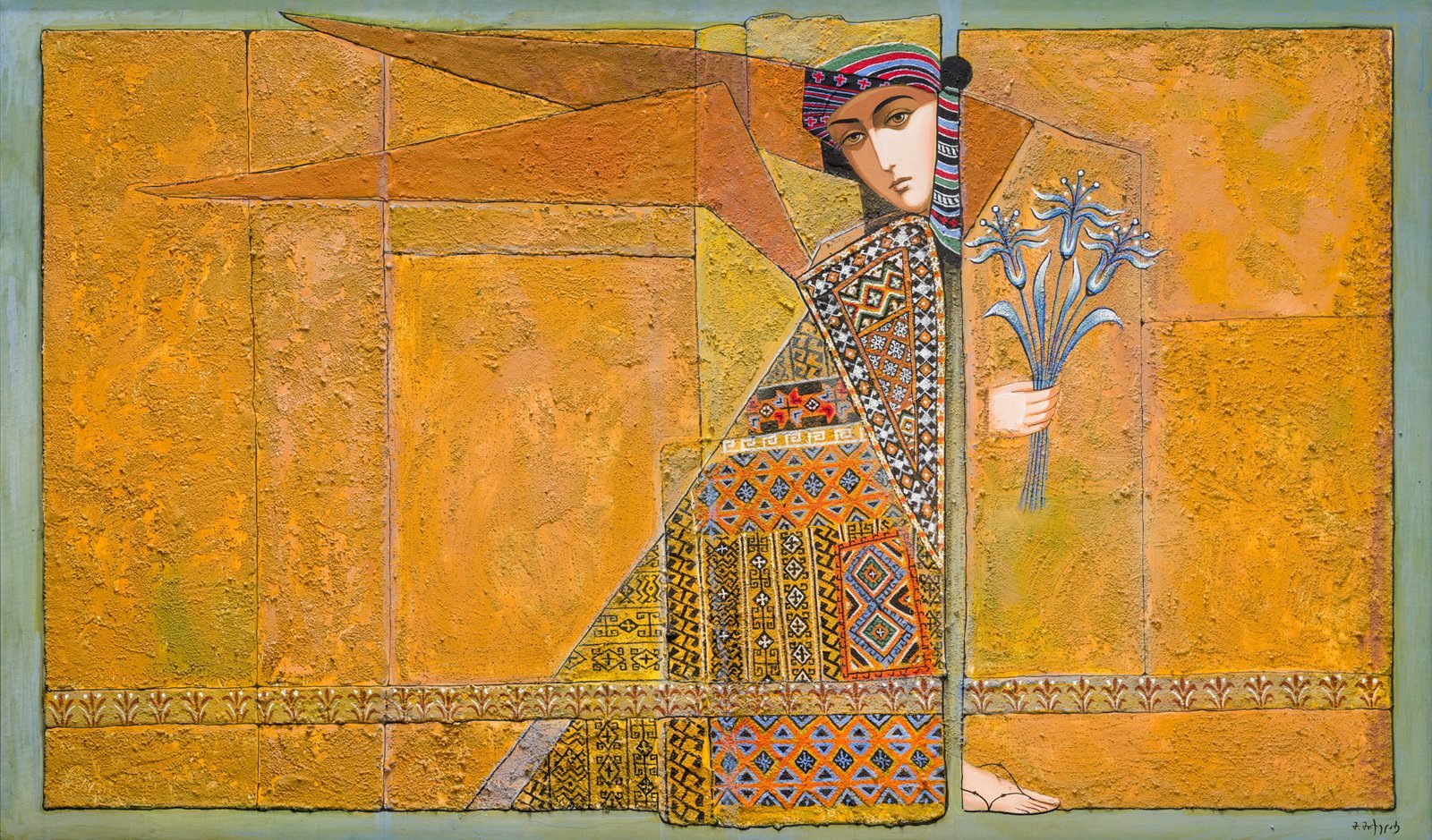
In Mamuka Mikeladze’s The Girl from Khevsureti (2017), a young woman stands at the center of the painting, turned slightly as if she has just looked back. She is dressed in traditional clothing from the region and holds a small wildflower in her hands. It is a quiet gesture, but it becomes one of the most memorable parts of the work.
The landscape around her is built from warm, earthy color. Orange, yellow, and brown tones suggest rock, soil, and mountain light, while sharp areas of green bring in the feeling of grass and alpine growth. Together, these colors create the impression of Khevsureti’s rugged terrain. The place does not feel realistically described. It feels remembered, shaped by mood, texture, and association.
Mikeladze does not treat the landscape as a background only. It presses around the figure and becomes part of her presence. The rough textures and dense colors give the painting a physical weight, as if the viewer is standing close to stone, earth, and mountain air. At the same time, the figure remains still and separate. She belongs to the place, but she also seems slightly removed from it.
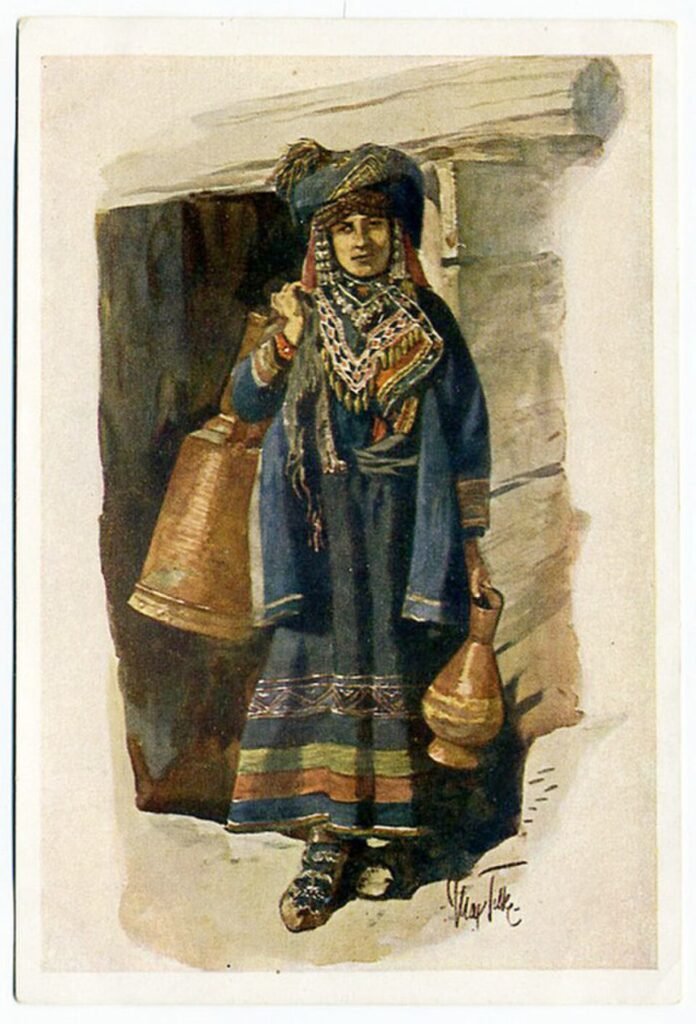
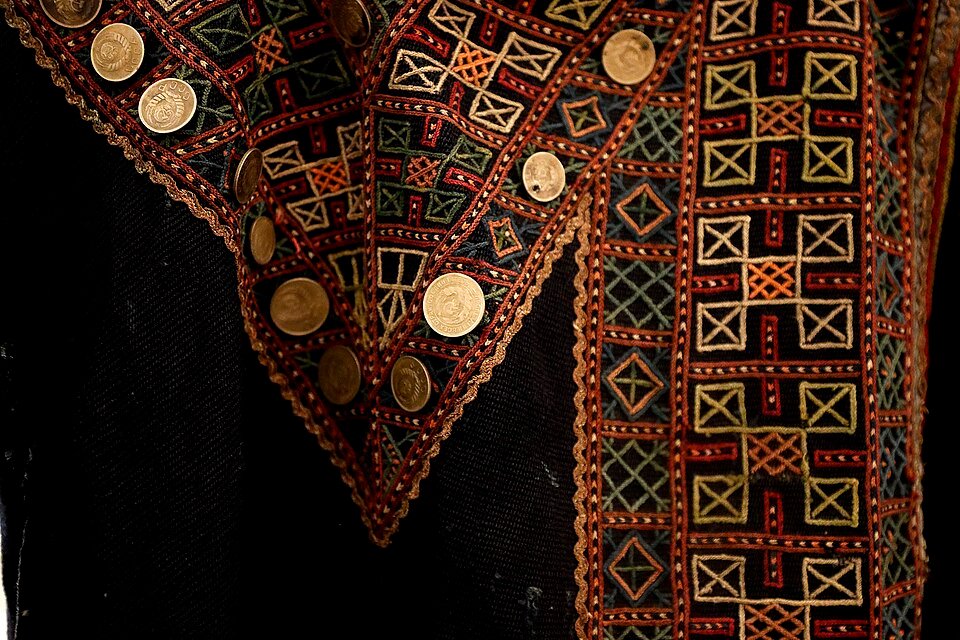
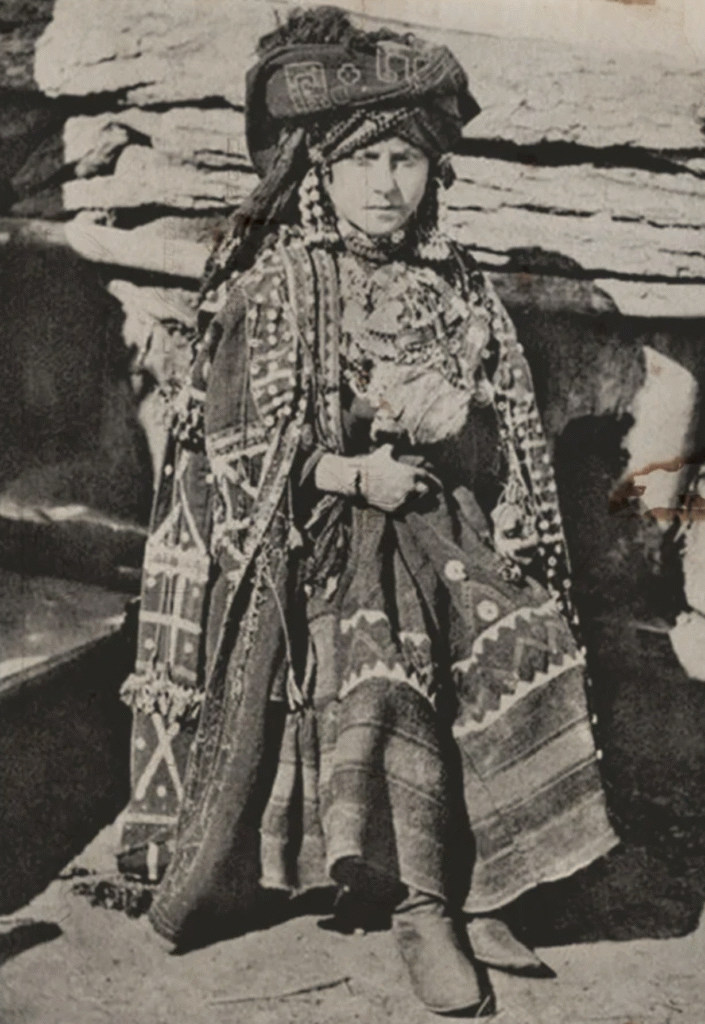
Her clothing connects her directly to Khevsureti and to the visual memory of the region. The covered head, the strong outline of the face, and the vertical structure of the figure recall traditional Georgian forms. There is also a religious undertone. The way the figure is positioned, the flattened space around her, and the faint suggestion of wing-like shapes behind her bring to mind frescoes from Georgia’s mountain churches. The painting does not copy religious imagery, but it borrows something from its stillness and gravity.
This connection is important in Mikeladze’s work. Born in Tbilisi in 1959, he studied at J. Nikoladze Art School before continuing at the Tbilisi State Academy of Arts, where he trained in painting and restoration. During his early career, he worked on the restoration of frescoes in ancient Georgian cultural monuments. That experience shaped the way he thinks about image, surface, and time.
You can see that background in The Girl from Khevsureti. The surface feels worked and layered. The colors have a raw, mineral quality. The figure is not modeled in a soft academic way, but built through line, shape, and frontal presence. These choices connect the painting to fresco traditions while keeping it firmly within a contemporary language.
Mikeladze’s career has moved through several fields: restoration, film design, church painting, mural work, and easel painting. He worked at the Georgian film studio Kartuli Filmi, restored monuments through the Main Department of Monument Protection, and later created fresco and mural projects in Georgia, Italy, and France. This range matters because his paintings do not come from studio practice alone. They carry the experience of old walls, sacred interiors, folk imagery, and public cultural memory.
At the same time, his work is not simply nostalgic. He does not recreate the past as decoration. Instead, he brings older Georgian visual traditions into a more modern, personal space. In The Girl from Khevsureti, the result is a painting that feels both ancient and current. The figure could belong to folklore, memory, religion, or real life. The painting allows all of those readings to exist at once.
The strength of the work lies in this ambiguity. It gives the viewer a clear image, but not a closed explanation. The girl stands before us, quiet and self-contained, surrounded by a landscape that feels almost symbolic. She is part of Khevsureti, but she also becomes something larger: a figure of memory, place, and continuity.
The Girl from Khevsureti is not loud. It does not rely on dramatic movement or obvious storytelling. Its power comes from stillness, texture, and the slow recognition of its references. The longer one looks, the more the painting opens: first as a portrait, then as a landscape, then as a meditation on Georgian identity and the way tradition survives through image.
The Girl from Khevsureti — Mamuka Mikeladze, 2017. Acrylic on canvas.
You may check out all the available products and buy some in the shop.
Continue Shopping